
Table of Contents
Toggle🌱 Elderly Gardening Made Easy: Common Problems (and Proven Solutions That Work)
Gardening is something many people enjoy for decades. It provides fresh air, exercise, purpose, and the simple satisfaction of watching something grow. But as people get older, gardening can begin to feel more physically demanding than it once did. Tasks that used to feel easy—bending down, carrying compost bags, watering plants, or moving pots—can slowly become uncomfortable and exhausting.

For many elderly gardeners, this creates frustration because they still love gardening but struggle with the physical side of it. The good news is that gardening does not need to stop with age. In fact, with the right setup and a few smart adjustments, gardening can become easier, more enjoyable, and even healthier than before.
🧍♂️ Bending, Kneeling, and Back Strain
One of the biggest challenges elderly gardeners face is the constant bending and kneeling involved in traditional gardening. Ground-level planting requires repeated movements that place pressure on the knees, hips, lower back, and joints. Even simple tasks like planting seedlings, pulling weeds, or harvesting vegetables can become painful over time.
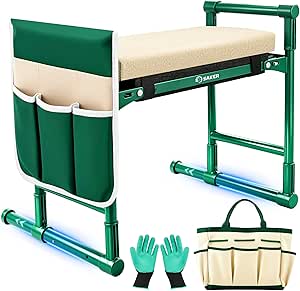
Saker Garden Kneeler and Seat – Gardening Bench
For some people, this discomfort becomes more than an inconvenience. It can increase the risk of injury or make gardening feel physically draining instead of relaxing. Many older gardeners find themselves spending less time outdoors simply because their bodies struggle with the constant strain.
This is where raised garden beds become a complete game changer.
Raised beds lift the soil higher off the ground, meaning gardeners no longer need to crouch or kneel constantly to reach plants. A waist-height raised bed allows planting, watering, and harvesting to happen while standing comfortably or sitting on a garden stool.
This simple adjustment dramatically reduces physical strain and makes gardening feel accessible again. Many elderly gardeners discover they can spend far longer in the garden once the pressure on their back and knees is removed.
Raised beds can also be designed with accessibility in mind. Narrower beds allow easy reach from either side, while perimeter ledges create a place to sit during gardening sessions. Some gardeners even position raised planters close to patios or pathways so everything stays within easy reach.
Rather than fighting against physical limitations, raised beds adapt gardening to suit the gardener.
🪴 : Heavy Lifting and Physical Effort
Traditional gardening often involves far more heavy lifting than people realise. Bags of compost, large watering cans, clay pots, tools, and soil can quickly become difficult to manage as strength and mobility change with age.
Many injuries in the garden happen not because of gardening itself, but because of lifting awkward or heavy materials incorrectly. Carrying wet soil, moving containers, or dragging hoses across the garden can all place unnecessary strain on the body.
Thankfully, modern gardening solutions make this much easier.
Lightweight planters made from resin, plastic, or fabric materials remove much of the physical effort involved in gardening. Fabric grow bags, for example, are extremely light compared to traditional pots and can still grow healthy vegetables successfully.
Raised planters on legs are another excellent solution because they eliminate the need to bend while also reducing the amount of lifting required. Instead of carrying large containers or working directly on the ground, gardeners can work comfortably at standing height.
Simple adjustments also make a big difference. Buying smaller bags of compost, using wheeled carts, or filling raised beds gradually instead of all at once reduces strain significantly.
The goal is not to make gardening effortless—it is to remove unnecessary physical stress so energy can be focused on enjoying the process itself.
🚶3: Limited Mobility and Difficult Garden Layouts
Large gardens may look appealing, but for many elderly gardeners they can become difficult to manage. Long walks between beds, uneven paths, steep steps, or awkward layouts can turn gardening into an exhausting task.
As mobility changes, efficiency becomes more important than size.
A smaller, well-organised garden is often far more productive and enjoyable than a large garden that becomes difficult to maintain. Raised beds and compact layouts allow gardeners to keep everything within easier reach while reducing unnecessary walking and movement.
Wide, flat paths are especially important because they improve safety and accessibility. Uneven ground or slippery surfaces can quickly become dangerous, particularly after rain.
Many elderly gardeners now choose to position raised beds closer together in organised rows or U-shaped layouts. This keeps tools, plants, and water sources nearby and allows gardening tasks to feel more manageable.
Patio gardening is also becoming increasingly popular because it places everything close to the home. A few raised beds or planters positioned near a seating area can create a productive garden without requiring large amounts of space or movement.
The focus shifts from having the biggest garden possible to creating one that is easier to enjoy consistently.
💧 4: Watering Becomes Exhausting
Watering may seem like a simple task, but it often becomes one of the most physically demanding parts of gardening for older adults. Dragging heavy hoses, lifting watering cans, and maintaining regular watering schedules can quickly become tiring, especially during warmer weather.
Unfortunately, inconsistent watering can lead to stressed plants, poor harvests, and additional maintenance problems.
This is why low-effort watering systems are becoming essential for elderly gardeners.
Drip irrigation systems, soaker hoses, and self-watering planters dramatically reduce the amount of physical effort required while also improving plant health. Instead of manually watering each plant every day, these systems slowly deliver moisture directly to the roots where it is needed most.
Timers can also automate watering completely, removing the pressure of remembering schedules during hot weather.
Mulching is another simple but highly effective solution. Adding mulch around plants helps soil retain moisture longer, meaning less watering is needed overall.
These adjustments allow gardeners to spend less time struggling with maintenance and more time enjoying their garden.
🌞 5: Fatigue and Overexertion
Gardening is enjoyable, but it can also become physically draining if too much is done at once. Many elderly gardeners experience fatigue more quickly than they used to, especially during hot weather or longer gardening sessions.
This often leads to a frustrating cycle where the garden becomes harder to maintain because tasks are postponed until they feel overwhelming.

The solution is not to stop gardening—it is to garden differently.
Breaking gardening into shorter, manageable sessions makes a huge difference. Working for 20–30 minutes at a time allows people to stay productive without exhausting themselves.
Choosing the right time of day is also important. Early mornings and evenings are usually cooler and more comfortable than midday heat.
Using seating areas, garden stools, and ergonomic tools can also reduce strain significantly.
Low-maintenance crops are another smart choice. Vegetables and herbs that grow reliably without constant attention help gardeners maintain productivity without unnecessary stress.
Gardening should feel sustainable and enjoyable rather than physically overwhelming.
🧠 6: Overwhelm and Too Much Information
Modern gardening advice can sometimes feel confusing and contradictory. One article recommends one method while another suggests something completely different. For elderly gardeners—especially beginners—this can quickly become overwhelming.
Too much information often leads to hesitation and inaction. People become unsure where to start or worry about making mistakes.
The best solution is simplicity.
Rather than trying to grow everything at once, successful gardeners often focus on a few reliable crops and build confidence gradually. A simple seasonal plan removes confusion and creates structure throughout the year.
This is why gardening guides, planners, and step-by-step systems are becoming increasingly popular. They reduce guesswork and make gardening feel far more approachable.
The goal is not perfection. The goal is creating a simple system that works consistently.
🌿 Why Raised Beds Are the Best Long-Term Solution
Raised beds solve multiple problems at the same time, which is why they have become one of the most popular gardening methods for older adults.
They reduce physical strain, improve drainage, simplify maintenance, and make gardens easier to organise. Because the soil warms up faster and remains easier to manage, plants often grow more successfully in raised beds than traditional ground plots.
Most importantly, raised beds adapt gardening to the gardener rather than forcing the gardener to struggle with traditional methods.
For many elderly gardeners, raised beds are not simply convenient—they are transformational.
🌱 Final Thoughts: Gardening That Grows With You
Gardening does not need to become harder with age. In many ways, older gardeners are often the most knowledgeable and experienced growers. The key is adapting the environment to match changing physical needs.
Raised beds, lightweight planters, compact layouts, and low-maintenance systems allow people to continue gardening safely and comfortably for years to come.
With the right setup, gardening can remain what it was always meant to be: relaxing, rewarding, healthy, and deeply enjoyable.
🌿 Start Gardening the Easier Way
If you want to build a garden that is simpler, smarter, and easier to maintain:
👉 Visit Bestraisedgardenbeds.com
Discover raised bed systems, practical guides, and beginner-friendly gardening ideas designed to make gardening more enjoyable at any age 🌱